The Divine Resonance of the Universe
Long before the Monochord became an instrument for therapeutic sound, it carried a much larger idea.
For Pythagoras, the Monochord revealed that musical harmony arises from precise mathematical relationships. A single vibrating string could demonstrate the intervals of the octave, fifth and fourth — suggesting that harmony was not arbitrary, but an expression of an underlying natural order.
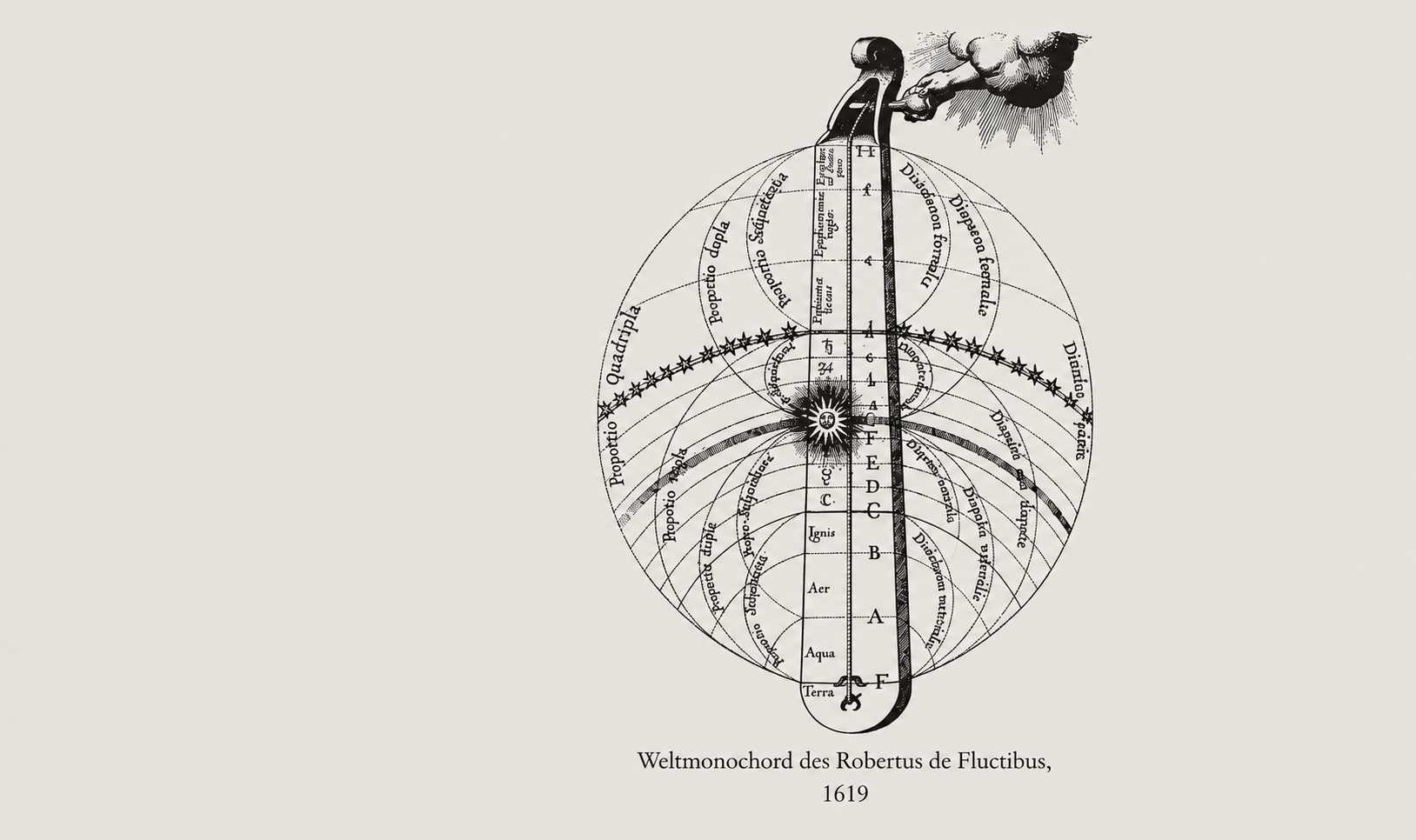
Centuries later, the English physician and philosopher Robert Fludd gave this ancient idea a magnificent visual form in his Monochordum Mundi — the World Monochord by Robertus de Fluctibus, 1619.
Fludd imagined the entire universe as a single musical instrument: one string stretching from Earth through the elements, the planets and the celestial realms toward the Divine. In his famous image, a hand emerging from the heavens tunes the cosmic string.
The universe, in this vision, is not a collection of separate things.
It is a living field of relationship, proportion, vibration and resonance.
And the human being is not separate from this harmony. The same principles that order the greater cosmos — the macrocosm — are reflected within the human being, the microcosm. The Sun appears near the center of Fludd's cosmic harmony, corresponding symbolically to the heart: a meeting place between above and below, inner and outer, matter and spirit.
Where Craftsmanship meets Resonance
There is a difference between making an object that produces sound and creating an instrument that carries resonance.
For more than two decades, the Deutz KlangWerkstatt in Berlin has been devoted to the latter.
Founded by Bernhard Deutz, the workshop grew from his fascination with the monochord, the art of violin making, and the extraordinary world of overtone-rich sound. From the beginning, his vision was not simply to build beautiful instruments, but to explore how craftsmanship, proportion, vibration and human experience could come together in a single resonating body.
What emerged is an extraordinary family of original instruments — conceived for intuitive playing, meticulously handcrafted, and created to make sound not only audible, but tangible. Bernhard's earliest inspiration came through the Chrotta and the monochord — instruments whose apparent simplicity reveals an astonishing richness of overtones.
His curiosity led him deeper into traditional instrument making and eventually toward something entirely his own: the creation of beautifully crafted string and resonance instruments that are simple to play, yet sophisticated in their construction and sound.
At the heart of this work was also a deeply personal longing — Bernhard's desire to be inside the sound.
That search became one of the creative forces behind instruments designed not only for musicians, but also for music therapy, sound work, contemplative practice and experiences in which listening becomes something more than hearing. To be surrounded by sound. To feel it. To enter it.
Original by Design
Every instrument created by the Deutz KlangWerkstatt begins with an original design.
They are not variations of conventional instruments adapted for therapeutic use. Their forms, proportions, stringing, resonating surfaces and construction have been developed specifically around the way each instrument is intended to sound, vibrate and be experienced.
The result is a distinctive balance: refined craftsmanship and intuitive simplicity. An instrument can be exquisitely made without requiring years of musical training to enter into relationship with it. A hand touches a string. The instrument responds. And resonance begins.
Nothing in these instruments is accidental
The proportions of the inner structure, the bracing of the soundboards, the tension and composition of the strings, the placement of tuning pins and bridges — each element is considered as part of one interconnected resonating body. Selected tonewoods are carefully seasoned over time. Mountain spruce and maple meet woods such as cherry, ash, birch, plum and walnut, each bringing its own grain, character and acoustic qualities.
Strings are calculated specifically for the instruments and custom manufactured to create balanced tension and a responsive playing experience. Even details that may appear invisible to the eye have been refined through years of experimentation.
Because in an instrument devoted to resonance …. every detail becomes part of the sound.
The Art of the Curved Soundboard
Some of the KlangWerkstatt's most refined instruments feature beautifully curved resonating surfaces.
Creating them requires a specialized technique developed within the workshop: carefully selected resonance wood is shaped across the grain using water and heat. The curvature creates natural internal tension within the soundboard. The result can be felt immediately.
The strings respond to the lightest touch. They continue resonating longer. The sound opens outward with remarkable presence and spatial depth. Less effort is needed from the player. The instrument seems almost eager to respond. At the same time, the curved construction brings greater structural strength — supporting tuning stability and longevity.
Form, function and sound become one.
Wood With a Life of Its Own
The wood is never merely decorative. Its age, grain, density and character become part of the identity of the finished instrument.
Some pieces are quiet and understated. Others carry extraordinary figuring, movement and contrast. Fine-grained spruce may become a resonating surface; flamed maple, walnut, ash or plum may give an instrument its unmistakable visual character. Surfaces are meticulously finished and protected with hard-wax oils or hand-applied natural resin varnishes made in the workshop.
Rather than hiding the material beneath the craftsmanship, the work reveals its uniqueness.
An Instrument That Comes Alive With You
Perhaps one of the most beautiful ideas within Bernhard's philosophy is that an instrument is not truly finished when it leaves the workshop.
Its fullest resonance develops through being played.
Rather than becoming diminished through use, these instruments can become increasingly alive as they are sounded and experienced over time. A therapist who knew Bernhard's work once described them beautifully as: “Instruments that are not only strung, but ensouled.” It captures something difficult to express in technical language. These are objects of craftsmanship. But they are made for relationship.
Between wood and string. Between hand and vibration. Between sound and body. Between the person playing and the person listening.
Handmade in Berlin
Every instrument is lovingly and carefully handcrafted in the Deutz KlangWerkstatt atelier in Berlin. Behind the instruments are years of experimentation, traditional craft knowledge, collaboration with skilled instrument makers, and — importantly — an ongoing dialogue with the people who actually use them.
Therapists, musicians, practitioners and customers have helped inform their evolution.
For Bernhard, this exchange has always been essential. New ideas are tested not only against ideals of craftsmanship, but against lived experience. And individual solutions remain part of the workshop's philosophy. Because sometimes the most beautiful instrument begins with a conversation.
From the Workshop to the World
For Bernhard Deutz, creating an instrument has never been the end of the work. An instrument must also be brought into the world. That means passing on knowledge — teaching people how to play and care for the instruments, how to build them, and how sound can be approached thoughtfully within educational and therapeutic settings.
It is here that the story of the Deutz KlangWerkstatt and Living Resonance meet.
Living Resonance exists to carry this remarkable body of work into North America while preserving the craftsmanship, philosophy and spirit from which it was born. Not simply to distribute instruments. But to build relationships around them. To let people hear them. To let people feel them.
And to create the conditions in which their resonance can continue to travel.